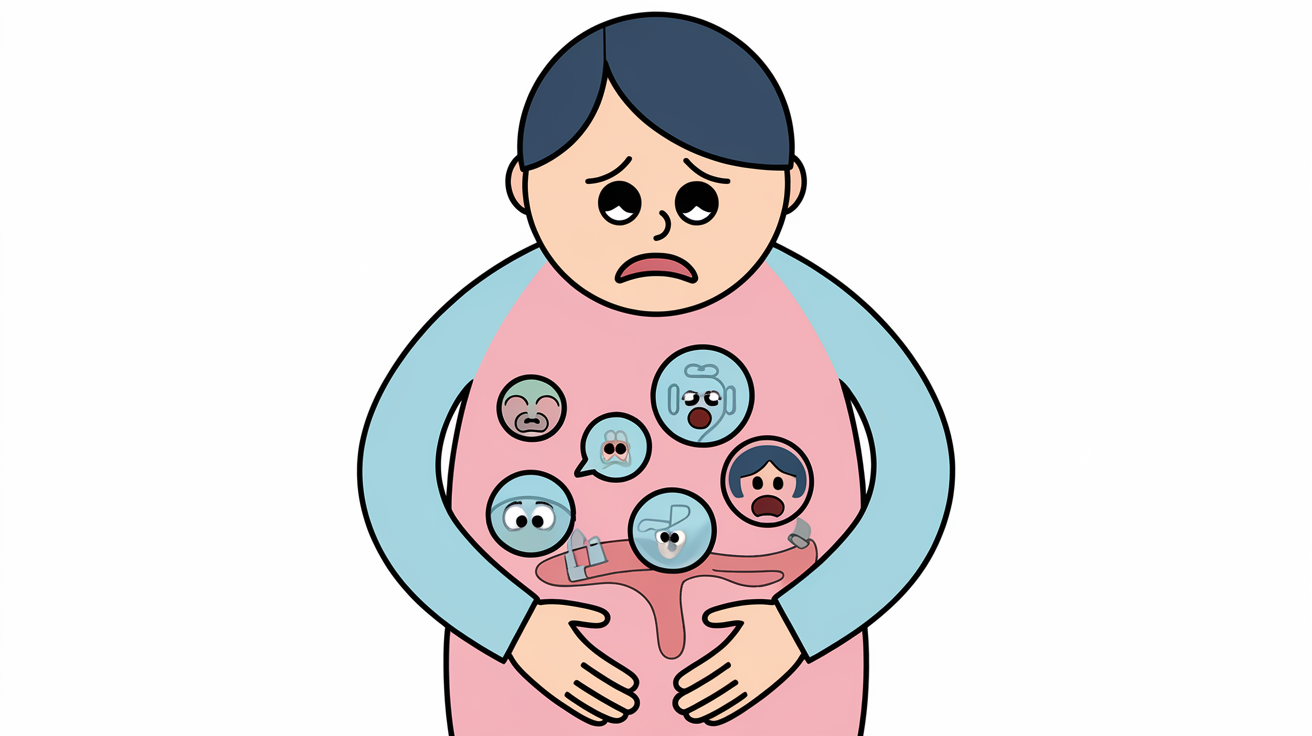
You can feel the gas right there. It's ready. But no matter how much you push, strain, or shift around—nothing happens. It's like there's a cork in there.
This experience is frustrating and can actually be quite painful. Let's understand why it happens and exactly how to fix it.
Why Farts Get Stuck
For gas to exit, several things need to work together: the gas needs to be in the right location (near the rectum), the puborectalis muscle needs to relax, and the anal sphincter needs to open. If any of these fail, gas stays trapped.
Think of your colon as a winding road with multiple bends. Gas can get stuck in any of these curves, especially:
- Hepatic flexure — Upper right bend of the colon
- Splenic flexure — Upper left bend of the colon
- Sigmoid colon — S-shaped section before the rectum
Until gas navigates past these bends and reaches the rectum, you can't release it.
Physical Causes of Trapped Farts
Most trapped gas issues come down to position and tension. Change your body position and relax the right muscles, and gas usually starts moving.
Step-by-Step Solutions
Work through these in order. Most people get relief by step 3 or 4:
-
Step 1: Get VerticalStand up immediately. Walking, even pacing, activates intestinal muscles and uses gravity to move gas. Do this for at least 5 minutes.
-
Step 2: Lie on Your Left SideThis positions your colon optimally for gas to travel toward the rectum. Lie here for 2-3 minutes while taking deep belly breaths.
-
Step 3: Knee-to-ChestStill on your back, hug both knees to chest. Rock gently side to side. This physically compresses the colon and pushes gas along.
-
Step 4: Deep SquatGet into a deep squat position (or sit on a very low stool). This straightens the anorectal angle—the same position used for pooping. Relax and breathe.
-
Step 5: All Fours, Head DownOn hands and knees, lower your head and chest while keeping hips high. This uses gravity to push gas toward the rectum. Gentle rocking helps.
-
Step 6: Abdominal MassageMassage in clockwise circles following colon path: start lower right, go up, across stomach, down left side. This manually pushes gas along.
Don't strain or push hard. Pushing against a tight sphincter just creates pressure—it doesn't release gas. Focus on relaxation and position changes instead.
When Trapped Gas Is an Emergency
Usually, trapped gas is just uncomfortable. But rarely, it can signal something serious.
- No gas OR stool has passed for 24+ hours
- Severe, worsening abdominal pain
- Visible abdominal distension that's hard
- Vomiting (especially if it smells fecal)
- Fever with abdominal symptoms
- Blood in stool or vomit
These could indicate a bowel obstruction, which is a medical emergency. Don't wait.